

Christian Augustine Everard Greene (1878-1963), was born in Switzerland, where his father was working as a civil engineer. His mother was Cuban. Everard, known as Kitten in the family after a younger sibling mispronounced his first name, was raised in Suffolk by his grandparents after his father died when he was 11. He co-founded British Tabulating Machines (BTM) in 1907. Some accounts of the history of computing state that Everard was an engineer and graduate of Cambridge University but I can’t verify either of these claims.
The Cambridge University alumni database makes no mention of him. In his own account (The Beginnings) he reports that Ralegh Phillpotts (fellow founder of BTM) initially wrote to him in 1903 saying ‘your knowledge of handling small electrically operated machines and your turn for electricity would suit you to to understand the working of this (Hollerith) machine.’
Everard goes on to say that he was seeking adventure and was attracted to visiting the US. He went to Washington DC and met Dr Hollerith to assess his tabulating machine, that had been used to analyse the US census since 1890. He says ‘the time spent there was very short, and it was often something of a shock to ponder the fact that, being neither an expert electrician nor an engineer, it was still necessary for me to “divine” a whole lot of principles with which I was quite unfamiliar and with which it was essential for me to cope, if machines were to be taken back to England, set up, operated and made to produce results which would convince interested, but also sceptical, prospective customers!’
Hollerith put Everard on the payroll and he spent the next few months in the factory learning how to build and maintain both the tabulating machine and the hole punching machines for the operating cards. Everard’s relationship with the Hollerith family became lifelong, with Dr Hollerith’s three daughters visiting London every year and Everard’s family visiting the Hollerith mansion in Georgetown, Washington DC.
Everard was General Manager of BTM until he joined the board in 1936, and retired in 1951. He was also a partner of Dora’s company, the Calculating & Statistical Service (CASS), from its foundation in 1924. He was mentor, business partner and close friend to her throughout his life, the pair sharing a deep knowledge of and passion for the early computing industry. His paternal grandfather (William Greene) and Dora’s (Henry Greene) were brothers.
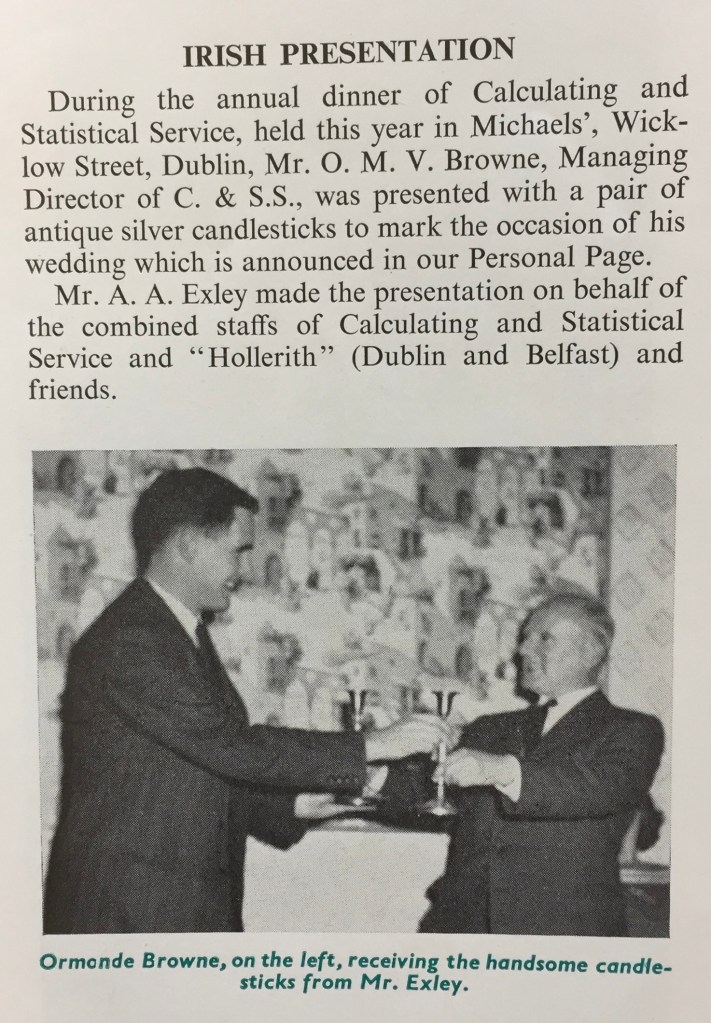
Everard married Venetia Gladys Wigram in 1908 and had 4 children. He recruited his brother in law, Max Browne, to work for BTM and Max’s son, Ormond Browne, eventually became Managing Director of CASS.
Kitten is remembered fondly by his grandchildren as an immensely kind and brilliant man. He was a keen cricketer, captaining the Incogniti CC team (a long established ‘wandering’ club that toured internationally) and encouraging cricket among the BTM workers.

